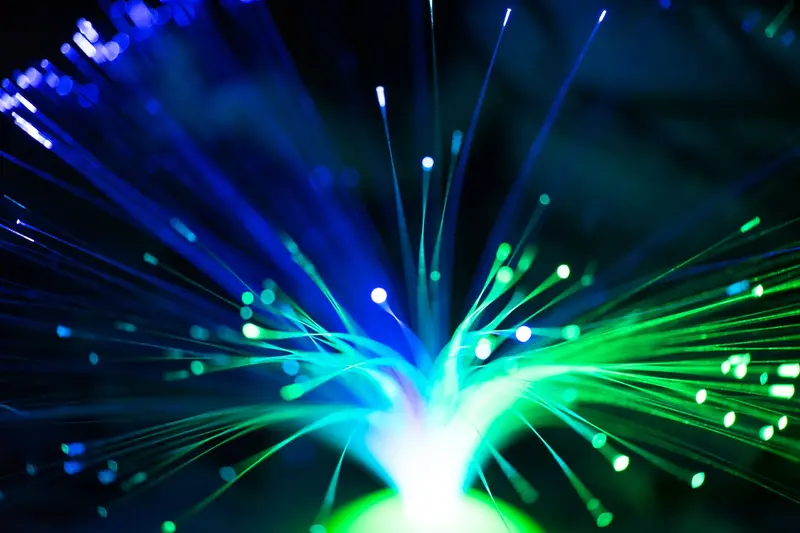
An optical fiber is a strand of glass about as thick as a human hair that guides light from one end to the other, even around gentle bends. Switch a laser on and off billions of times per second at one end, and a detector at the far end sees the same pattern of pulses. Those flashes are the ones and zeros of digital data. Long-distance internet traffic, the links between data centers, and much of the wiring inside modern telephone and cable networks all rely on this arrangement.
Light can carry far more information than electrical signals in copper because its frequency is enormous, hundreds of terahertz, leaving room for very fast modulation and for many separate colors of light to share one strand. But turning that potential into a working cable required solving two problems: keeping light inside a thin glass thread, and making the glass clear enough that the light survives long trips.
Trapping Light Inside Glass
The trick is called total internal reflection. When light passes from one transparent material into another with a lower refractive index, it bends away from the perpendicular. If it strikes the boundary at a shallow enough angle, it does not cross at all, and instead reflects completely back. You can see a version of this underwater, where the surface looks like a mirror from certain angles.
A fiber exploits this by using two glass layers. The central core has a slightly higher refractive index than the surrounding cladding. Light traveling inside the core along nearly the fiber's axis meets the boundary at a shallow angle and reflects back inward, again and again, along the whole length. The Fiber Optic Association gives the example of a core index of 1.46 and a cladding index of 1.45: rays within about 7 degrees of the axis are captured. That limit is described by the fiber's numerical aperture, a standard specification. Anything entering at a steeper angle leaks into the cladding and is lost.
The fiber is then coated with a protective plastic layer, and many fibers are bundled inside a cable with strengthening elements. The glass carries the signal; the rest of the cable simply keeps it from bending too sharply, stretching, or getting wet.
Single-Mode and Multimode
Fibers come in two broad kinds. Multimode fibers have a core wide enough for light to take many distinct paths. Some rays travel straight down the middle and others zigzag, so pulses that started together arrive at slightly different moments and smear into each other. This spreading limits both distance and speed, so multimode fiber is used mainly inside buildings and short links.
Single-mode fiber has a core only a few times wider than the wavelength of the light, so essentially one path is supported. Pulses stay sharp, and signals can travel much farther. This is the type used in long-distance networks. The first transatlantic optical cable used single-mode fiber at a wavelength of about 1.3 micrometers, in the infrared, together with lasers and detectors matched to it.
Why the Glass Must Be So Pure
Ordinary window glass is fine for looking through but hopeless for sending light over kilometers. Impurities such as metal ions absorb light, and microscopic irregularities scatter it. In the 1960s, the best glass fibers lost most of their light within tens of meters, which made them useful for short medical or decorative uses but not for communication.
In 1966, Charles Kao, then working at Standard Telecommunication Laboratories in England, calculated that the main losses in glass came from impurities rather than from the material itself. Fibers made of far purer glass, he argued, could carry light for great distances. That work was recognized with a share of the 2009 Nobel Prize in Physics. Glassmakers went on to achieve the required purity, and modern telecom fiber loses only a small fraction of its light per kilometer. Engineers also choose infrared wavelengths, near 1.3 and 1.55 micrometers, where absorption and scattering in silica glass reach their lowest levels.
Boosting the Signal
Even the best glass eventually dims the light. On long routes, signals need to be strengthened. Early submarine systems converted the light to electricity, cleaned up and re-timed the pulses, and converted back to light using a laser. TAT-8 used repeaters like this, separated by tens of kilometers, though far fewer than the copper systems it replaced.
Later systems used optical amplifiers, in which a section of fiber doped with erbium is energized by a pump laser and boosts passing light directly, without converting it to electricity. Because an optical amplifier does not care about the exact data format, it can strengthen many colors at once. That leads to wavelength-division multiplexing, in which many independent signals, each on its own color, share one fiber, multiplying capacity.
From Laboratory to Ocean Floor
Corning researchers demonstrated low-loss fiber in 1970, and commercial telephone links followed in the late 1970s. The milestone that changed global communication came on December 14, 1988, when TAT-8 entered service as the first optical cable across the Atlantic. It could handle 40,000 simultaneous telephone calls, about ten times the capacity of the last copper cable. Its story continues in how undersea cables keep the internet connected.
Today, fiber reaches much closer to homes. The router behind your Wi-Fi connection may connect to a fiber line, and the servers behind cloud storage exchange enormous volumes of data over it. Fiber competes with and complements satellite links, which excel at reaching remote places and moving vehicles rather than raw capacity.
Limitations and Misconceptions
Light in glass does not travel at the vacuum speed of light. With a refractive index near 1.46, it moves at roughly two thirds of that speed. Fiber therefore adds delay proportional to distance, which is one reason a straight, short route matters to applications that need quick responses.
Fibers are not indestructible. Glass can fracture, sharp bends leak light out of the core, and connectors demand very clean, precise alignment because even dust on the end can block the tiny core. Splicing requires special equipment.
Another common misconception is that data travels inside the fiber as a beam bouncing like a ball. The picture is useful, but light is really a wave whose electromagnetic field is guided by the structure. It is also wrong to think a fiber carries electricity; the glass is an insulator, which is a practical benefit, since fiber is immune to electromagnetic interference and cannot cause sparks.
In Short
A fiber is a two-layer glass thread that traps light by total internal reflection. Ultra-pure glass, infrared wavelengths, and single-mode cores let pulses travel very far, and amplifiers and multiple colors of light multiply what one strand can carry. That combination is why glass, not copper, forms the backbone of modern long-distance communication.