A communications satellite is best imagined as a radio relay station placed high above the ground. Radio waves used for most long-distance links travel in nearly straight lines and do not follow the curve of the planet. A tall mountain can extend a radio link's reach; a satellite extends it much further. Because it sees an enormous stretch of Earth at once, a station in one hemisphere can send a signal up and have it come down at a station thousands of kilometers away.
NASA describes a satellite simply as a body that orbits another body in space, and a man-made one transmits its information to ground antennas using radio waves. What separates one kind of satellite from another is what it carries and, above all, where it flies. Orbit height decides how much of the planet the satellite covers, how long signals take, and how many satellites are needed.
How a Relay Works
A ground station points a large dish at the satellite and transmits at a certain frequency called the uplink. The satellite's antenna collects the extremely weak signal. Inside is a transponder, an electronic chain that amplifies the signal, shifts it to a different frequency, and sends it back toward Earth as the downlink. The frequency change is essential: a transmitter cannot easily send at the same frequency it is receiving without drowning out the very signal it is trying to hear.
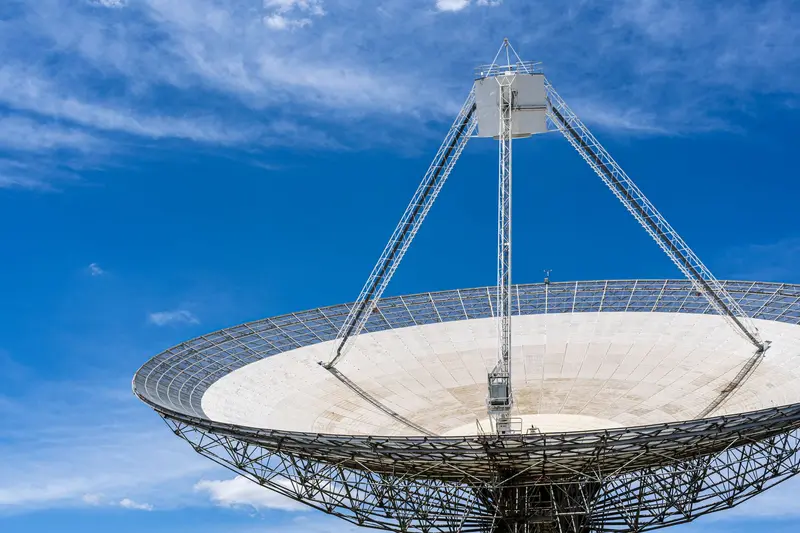
Satellites are powered by solar panels and carry antennas shaped to concentrate their radio energy on a chosen region, so the beam covers a country or a continent rather than spraying power into space. On the ground, a dish gathers the faint downlink and focuses it onto a sensitive receiver. Because signals are so weak, large dishes and low-noise electronics are part of the design. Since many customers share a satellite, the available spectrum is divided among them by frequency, time slots, or coding.
Why Orbit Height Matters
A satellite stays up because it falls around the Earth. The higher the orbit, the slower it moves. NASA classifies Earth orbits into low, from just above the atmosphere to roughly 2,000 kilometers, medium, from about 2,000 kilometers up to geosynchronous altitude, and high, above that. GPS satellites, for example, sit in medium orbit at about 20,200 kilometers, the same orbits discussed in why GPS depends on extremely precise clocks.
At an altitude of about 35,786 kilometers, the orbital period matches Earth's rotation, 23 hours, 56 minutes, and 4 seconds. A satellite there, above the equator, seems to hang motionless above a fixed point on the ground. This is geostationary orbit, and it is uniquely useful: a home dish can point at it once and never move. A single geostationary satellite sees roughly a third of the planet's surface, and three properly spaced can cover most of the inhabited world, though not the polar regions.
From Fiction to Hardware
The idea was set out in 1945, when Arthur C. Clarke published an article titled "Extra-Terrestrial Relays" in the magazine Wireless World, suggesting that satellites at this altitude could provide worldwide radio coverage. Hardware followed within two decades. Echo 1, a large metallic balloon launched in 1960, simply bounced radio signals off its surface. Telstar, launched on July 10, 1962, was the first active communications satellite: it received, amplified, and retransmitted signals, and it relayed the first live television pictures across the Atlantic. Telstar flew in low Earth orbit, so it was visible to its ground stations only for short periods, which led to the expectation that a working service would need a fleet of them.
The response was Syncom. Syncom 2, launched in 1963, was the first satellite in geosynchronous orbit, and Syncom 3 in 1964 became the first in true geostationary orbit, and was used to relay coverage of the Tokyo Olympics. Early Bird, launched in 1965, is recognized as the first operational commercial communications satellite, and it led to the establishment of the global Intelsat system.
A Delay You Can Feel
The price of a high orbit is time. A signal must travel about 36,000 kilometers up and the same distance down. Even at the speed of light, one hop from ground to satellite to ground takes about a quarter of a second, and a question-and-answer exchange doubles that. That delay is noticeable in phone calls, awkward for interactive applications, and one reason bulk traffic between continents goes through undersea cables built on fiber optics, where delay is a small fraction of that. Low-orbit satellites reduce the delay because they are so much closer, but they move quickly across the sky and each covers a small area. Providing continuous service therefore requires a large constellation, with handoffs between satellites, and ground terminals that can track them.
Relays for Other Spacecraft
Satellites relay for spacecraft too. NASA's Tracking and Data Relay Satellite System places satellites in geosynchronous orbit so that low-orbiting spacecraft, such as the International Space Station and science satellites, can send data to them almost continuously rather than waiting for a ground station to pass beneath. Three active satellites are positioned around the equator, and together they can communicate with a user spacecraft for at least 85 percent of its orbit. That is far better than the few minutes of contact a single ground station offers.
Where Satellites Fit Today
Satellites serve where cables and towers cannot: ships at sea, aircraft, remote settlements, disaster zones, and broadcast television, where one transmission reaches millions of dishes at once. They also carry weather observation, navigation, and science data. Many aircraft offer connectivity through satellites, a topic touching on what airplane mode does and does not disable, and local wireless service inside the cabin then works like Wi-Fi.
Limitations and Misconceptions
Satellites also have finite lifetimes. Their solar panels degrade, their fuel for orbit corrections runs out, and operators eventually retire them, either by moving them to a higher disposal orbit or by letting them re-enter the atmosphere.
Satellites are not floating in "no gravity." At geostationary altitude Earth's gravity is still strong enough to keep them in orbit; they are weightless because they are in continuous free fall. Radio signals from satellites are also affected by weather: at higher frequencies, heavy rain can weaken the link. Geostationary orbit is a limited resource, since satellites must be spaced along a single ring above the equator, so positions and frequencies are coordinated internationally.
Finally, a satellite does not need a person "steering" it moment to moment. Ground controllers track it and command occasional adjustments, while onboard systems keep antennas pointed correctly.
In Short
A communications satellite receives a signal, shifts its frequency, amplifies it, and sends it back, extending radio's reach beyond the horizon. Its orbit sets everything else: geostationary satellites give fixed pointing and wide coverage at the cost of delay, while low orbits reduce delay but demand large constellations. That trade-off explains where satellites excel and why cables carry most of the world's long-distance data.