
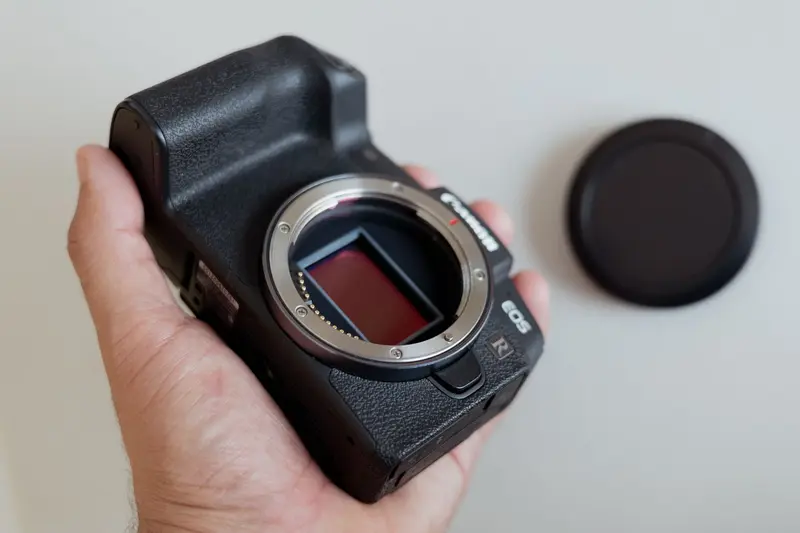
A camera sensor does not record a picture. It measures light. The surface of the chip is divided into millions of microscopic cells called photosites, or pixels, and each one behaves like a bucket left out in the rain: for the duration of the exposure it collects photons, and afterward the camera counts what it caught. Everything else, including color, sharpness, and the smooth tones of a portrait, is built from those counts by electronics and software.
The conversion works because of a property of silicon. When a photon of visible light strikes the semiconductor with enough energy, it can free an electron from its atom, a process known as the photoelectric effect. The more light that arrives, the more electrons accumulate in the pixel's electrical well. A bright pixel is one that gathered many electrons; a dark one gathered few.
From Photons to Numbers
At the end of an exposure, each pixel holds an amount of charge that is an analog quantity, not yet a number. The camera has to measure that charge, amplify it, and pass it to an analog-to-digital converter, which assigns it an integer. If the converter works with 12 bits, each pixel is described by a value from 0 to 4,095. The reading is a simple brightness: at this point the sensor has recorded a grayscale image.
The size of the pixels matters. A larger photosite has a bigger well and collects more photons in a given time, so its counts are less affected by the random variation of arriving light and by electronic noise. This is one reason a sensor with a large surface tends to perform better in dim scenes than a tiny one with the same number of pixels, and why cramming many pixels into a small chip has physical limits.
How Color Is Added
Silicon responds to a broad range of wavelengths, so a bare pixel cannot tell a red photon from a blue one. To capture color, manufacturers place a tiny colored filter over each pixel. The most common layout, the Bayer pattern, described by Kodak's Bryce Bayer, is a repeating mosaic in which every 2 by 2 block has two green filters, one red, and one blue. Green appears twice because human vision is most sensitive to that part of the spectrum, and brightness detail is best carried by green.
Each pixel therefore measures only one color. The two missing colors at every location are estimated in a step called demosaicing, which interpolates from neighboring pixels. Simple methods average the surrounding values, while more advanced ones look for edges so that a sharp boundary is not smeared. The full-color picture that appears on a screen is thus partly measured and partly reconstructed, a fact that occasionally shows up as odd colored fringes on fine patterns. A separate filter in front of the sensor also blocks infrared light, which silicon detects readily but people do not see.
CCD and CMOS: Two Ways of Reading Out
There are two dominant sensor designs. Both convert light to charge, but they differ in how the charge is collected.
The charge-coupled device, or CCD, was conceived in October 1969 at Bell Laboratories by Willard Boyle and George Smith, who were looking for a new kind of computer memory. In a CCD, electrical charge stays in each pixel until the exposure ends, then is shifted from cell to cell like a bucket brigade to a single output amplifier at the edge. This gives very uniform results, and the CCD became prized in astronomy. Boyle and Smith shared the 2009 Nobel Prize in Physics for the invention.
In a CMOS sensor, each pixel contains its own small set of transistors that converts the charge to a voltage and sends it along a column line. The chip can read out individual rows or windows and can place conversion circuits and processing on the same silicon. Extra transistors in the pixel reduce the area available for collecting light, so many modern sensors add a tiny lens over each pixel to funnel light onto the sensitive portion, and some reverse the chip so that the wiring sits behind the light-sensitive layer. CMOS designs now dominate consumer cameras because of their lower power use, speed, and integration.
An analogy for the whole sensor is a field of rain gauges laid out in a grid. After a shower, you read each gauge's water level and record it as a number. A photograph is a map of those levels; a sharper picture simply comes from a finer grid and from gauges that catch enough water to be read reliably.
The Shutter and Its Side Effects
Many CMOS sensors expose and read their rows in sequence, a method called a rolling shutter. Because the top of the frame is captured slightly before the bottom, fast horizontal motion or a spinning propeller can look skewed or wobbly. Global-shutter designs expose every pixel at the same instant and avoid the effect, at the cost of extra circuitry in each pixel.
Why It Matters in Daily Life
The output of a sensor is the raw material for everything from a family snapshot to the codes discussed in how a QR code stores information and how barcodes are scanned. A phone or camera turns that raw data into a viewable file through steps such as demosaicing, noise reduction, and the size reduction described in how compression shrinks files.
The same physics runs in reverse in a solar panel: light frees charge carriers in silicon, but instead of measuring them pixel by pixel, the panel collects them as current. Machines that navigate the world, covered in how robots perceive their surroundings, often depend on sensors of this kind as their eyes.
Limits and Misconceptions
More megapixels do not automatically mean a better image. Once the pixels become very small, each collects fewer photons, and the picture gets noisier in low light unless the sensor is larger. Lens quality, the amount of light, and image processing matter as much as the pixel count.
Another common belief is that a sensor sees the world the way the eye does. It does not. It has a limited range between the darkest and brightest levels it can distinguish, which is why bright skies often turn white when a shadowed subject is exposed correctly. Finally, pictures from a sensor are never a raw copy of reality: the color filters, the demosaicing, and the camera's tone choices all interpret the data.
In Short
A digital camera sensor is a grid of silicon photosites that convert photons into electrons, count them, and pass the numbers on. Color filters in a Bayer mosaic supply one color per pixel, and software estimates the rest. CCD and CMOS designs differ in how they read the charge out, but both rely on the same photoelectric principle, and the quality of the final image is set by how well that stream of counted light is gathered and interpreted.