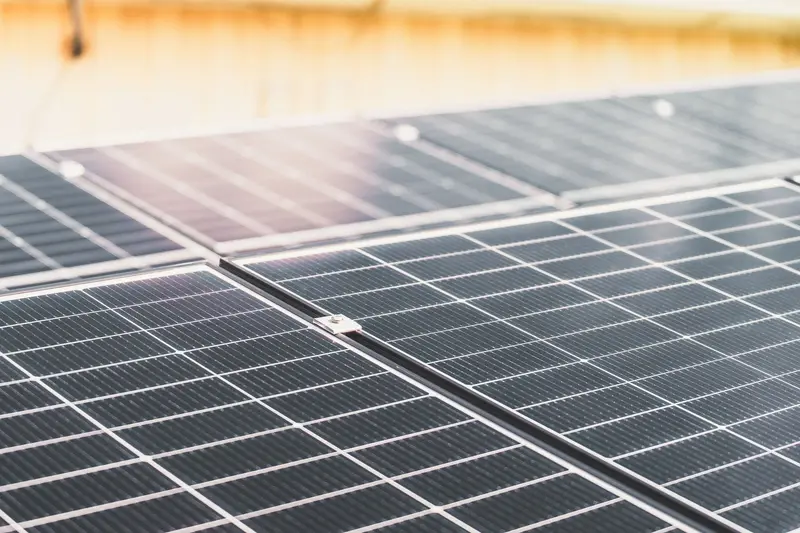
A solar panel is one of the few machines that turns light directly into electricity with no moving parts, no combustion and no working fluid. Sunlight strikes a thin sheet of semiconductor, and current flows. The simplicity of that description hides a piece of quantum physics that was not understood until the early twentieth century, and an engineering achievement that took another half century to make practical.
The process rests on the photovoltaic effect, in which light absorbed by a material frees electric charges and a built-in electric field pushes them in a consistent direction. Understanding it means understanding three things: what light gives a solar cell, why silicon is a good place to put it, and how a junction turns random motion into a current.
What Light Provides
Light arrives in packets of energy called photons. In 1905, Albert Einstein explained that the energy of each photon depends on the light's frequency, and that a photon can knock an electron loose from a material only if it carries enough energy. This explanation of the photoelectric effect earned him the 1921 Nobel Prize in Physics.
In a semiconductor like silicon, electrons normally sit in a band of energy states called the valence band, bound to their atoms. Above them lies a band of higher-energy states, the conduction band, where electrons can move freely. The energy gap between the two, called the band gap, acts like a toll. A photon with less energy than the gap passes through without effect. A photon with more energy lifts an electron across, leaving behind a mobile vacancy called a hole. The result is an electron-hole pair.
The Junction That Sorts Charges
Freed electrons alone do not make current. Left to themselves, they would wander and quickly fall back into holes, releasing their energy as a little heat. A solar cell needs something to sort them.
That something is a p-n junction. Pure silicon is doped, meaning it is deliberately contaminated with small amounts of other elements. Boron, for example, gives a region a shortage of electrons and makes it p-type. Phosphorus gives a region an excess and makes it n-type. Where the two regions meet, electrons from the n side diffuse across and fill holes on the p side, leaving the n side slightly positive and the p side slightly negative. This creates a permanent internal electric field across the boundary.
When light creates electron-hole pairs near the junction, that field sweeps electrons toward the n side and holes toward the p side. Metal contacts on the front and back of the cell collect them, and if those contacts are connected through a device, the electrons flow through it on their way back to the holes. The cell behaves like a battery whose energy source is light, but unlike a battery it is not consumed by supplying current. The thin metal lines you can see on the front of a cell are the collectors, and they must be thin because any metal covering the surface also blocks light.
From Cells to Panels
A single silicon cell produces only about half a volt, so a panel wires dozens of cells in series to add their voltages, and panels are wired in strings and arrays to reach the voltages and currents that a home or a power plant needs. The output is direct current, so a device called an inverter is used to convert it to alternating current for the electrical grid and for ordinary appliances. Panels are covered with protective glass and sealed against moisture, since water and dust are far more likely to end a panel's life than any failure of the physics.
A Brief History
The effect itself is old. The French physicist Alexandre-Edmond Becquerel observed it in 1839. In 1883, Charles Fritts built cells from selenium that converted less than 1 percent of light. In 1940, Russell Ohl at Bell Laboratories noticed current flowing through a cracked silicon sample when it was exposed to light, an accidental discovery of a p-n junction.
The breakthrough came at Bell Laboratories in 1954. Daryl Chapin, Calvin Fuller and Gerald Pearson demonstrated a silicon solar cell with an efficiency of about 6 percent, far better than earlier attempts. Chapin had been searching for a power source for telephone equipment in remote, humid places where dry batteries failed quickly. Within a few years, solar cells were powering satellites, and the Vanguard 1 satellite of 1958 used them. Space applications supplied the demand that kept the technology alive until costs fell enough for use on the ground. Today, satellites that carry communications still depend on large solar arrays.
Everyday Examples
Rooftop panels and utility-scale solar farms are the most visible uses, but photovoltaic cells also power pocket calculators, garden lights, parking meters and remote sensors. Because the sun's output varies, many installations pair panels with batteries; the chemistry behind that storage is covered in the article on how rechargeable batteries store energy. Interestingly, the reverse process also exists. A light-emitting diode is a junction that turns current into light, as described in how LED bulbs produce light, and camera sensors use the same light-to-charge conversion to record images.
Limits and Misconceptions
Efficiency is the fraction of incoming light energy that becomes electricity. For a cell with a single junction, there is a fundamental ceiling known as the Shockley-Queisser limit, roughly 33 percent for an ideal silicon-like cell. The ceiling exists because photons with too little energy are not absorbed, and photons with too much energy waste their surplus as heat. Commercial panels convert a fraction lower than the ceiling because of reflection, resistance and imperfections. Multi-junction cells stack different materials to capture more of the spectrum and can exceed the single-junction limit, though they are more complex.
Heat works against panels. As a silicon cell warms, its voltage drops, so a panel on a very hot day delivers less power than the same panel on a cold, clear one. Shade is also troublesome: when part of a series string is shaded, the shaded cells limit the current through their neighbors, which is why panels include bypass diodes that route current around blocked sections.
A common misconception is that solar panels need direct, hot sun. They need light, and they still work, at reduced output, under cloud, because diffuse light still carries photons. Another is that panels store energy. They do not; they generate power only while light is present, which is why storage is a separate component. A third is that panels absorb all the light that hits them. In fact, most of the light that reaches a cell is either reflected or turned to heat, and anti-reflective coatings are applied to keep as much light as possible inside the silicon.
In Short
A solar cell is a silicon sandwich with a built-in electric field. Photons lift electrons across the band gap, the field separates electrons from holes, and the resulting current flows through an external circuit as direct current. The idea was explained in 1905, made practical in 1954, and remains bounded by physical limits that no manufacturing improvement can erase.