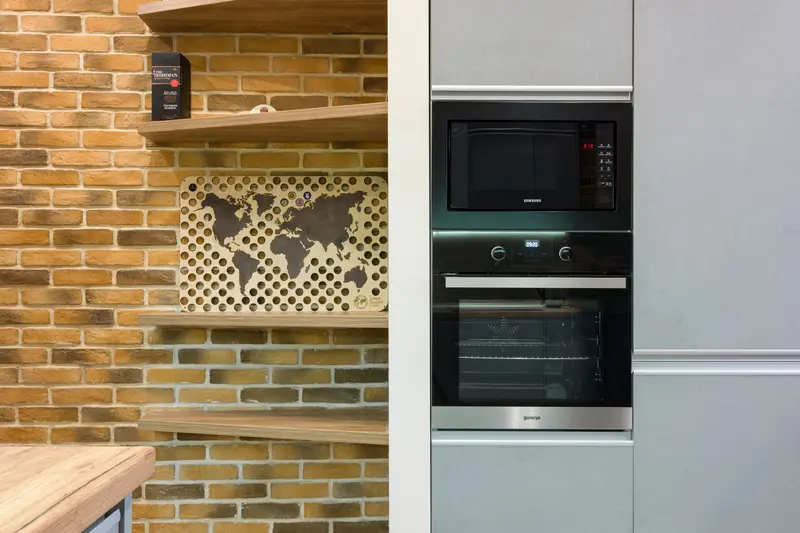
Few appliances feel as mysterious as the microwave oven. It has no flame, no glowing element and no hot surface, yet a bowl of cold soup emerges steaming a minute later. The explanation is neither magic nor anything unusual: it is a small, well-shielded radio transmitter aimed at a box of food, tuned to a frequency that water molecules absorb readily.
To see why that works, it helps to trace the path of the energy from the wall socket to the plate: a device that makes microwaves, a metal cavity that contains them, and a physical process that turns them into heat.
Making the Waves
Microwaves are electromagnetic waves, the same family as radio waves, Wi-Fi signals and visible light, distinguished by their frequency. Household ovens generally operate at about 2.45 gigahertz, which corresponds to a wavelength of roughly 12 centimeters. That frequency sits in a band set aside internationally for industrial, scientific and medical uses, so it is available without licensing and shared with wireless devices such as Bluetooth radios.
The wave source is the cavity magnetron, a vacuum tube. Inside, a central cathode emits electrons, and a strong magnet forces them into curved paths as they travel outward toward a metal block that has resonant cavities cut into it. As the electrons sweep past the openings, they set the cavities oscillating, much as blowing across a bottle mouth creates a tone. The size of the cavities fixes the frequency. A guide directs the resulting microwaves into the cooking chamber, where a stirrer or a turntable helps spread them around.
The magnetron was developed for radar. In 1940, John Randall and Harry Boot at the University of Birmingham built a version that produced hundreds of watts at a wavelength of about ten centimeters, far beyond earlier designs. It became a key component of Allied radar during World War II.
How Microwaves Heat Food
Most foods contain water, and a water molecule is polar. Its oxygen end carries a slight negative charge, and its hydrogen end a slight positive one. An electric field pulls such a molecule to line up with it. In a microwave oven, the field alternates direction billions of times per second, so molecules are constantly twisting back and forth as they try to follow it.
As they rotate, the molecules jostle against their neighbors, and the ordered motion is converted into random thermal motion. That is heat. Fats and sugars also respond, though water dominates in most meals. The process is called dielectric heating. A common belief is that 2.45 gigahertz is the resonant frequency of water, but that is not the case. Water absorbs microwaves across a broad range, and the frequency was chosen largely because it was available and practical.
Ice heats poorly because in a frozen lattice the molecules are locked in place and cannot rotate freely. That is why a frozen dinner often has hot patches next to icy ones: once a spot melts, it absorbs energy much more strongly and heats even faster.
Why Heating Is Uneven
Microwaves reflect from the metal walls, and the reflected waves overlap with the incoming ones. Where they add together the field is strong, and where they cancel it is weak, forming a standing-wave pattern. Food in a strong region heats quickly, and food in a weak region heats slowly. The turntable and the mode stirrer exist to move food through this pattern or to shuffle the pattern itself.
Depth matters as well. At 2.45 gigahertz, microwaves are absorbed within about a centimeter or so of the surface of most foods, so the outer layer takes in the energy directly. The interior warms mostly by ordinary conduction from the hot outer layer, the same way it does in a conventional oven. The idea that microwaves cook from the inside out is a myth. This is also why letting food stand for a minute after heating helps: temperatures even out.
The Discovery
Percy Spencer, an engineer at Raytheon who had helped scale up magnetron production during the war, noticed in 1945 that a candy bar in his pocket melted while he stood near an active magnetron. He followed up by testing popcorn kernels, which popped, and then other foods. Raytheon filed a patent on October 8, 1945, which was granted in 1950. The first commercial unit, called the Radarange, appeared in 1947. It was enormous by modern standards, weighing hundreds of pounds and standing about the height of a person. Compact home models arrived roughly two decades later.
The oven's kinship with wireless technology is not coincidental: a microwave oven is a transmitter that aims all its power into a closed box. Where a Wi-Fi router radiates a tiny fraction of a watt, an oven concentrates hundreds of watts, and that difference is the reason one carries data and the other cooks.
Safety and Shielding
The oven cavity is a metal box, and the door has a metal mesh in its window. Holes in the mesh are a few millimeters wide, much smaller than the 12-centimeter wavelength, so the microwaves cannot pass, while visible light, with its far shorter wavelength, passes freely. The result is often called a Faraday cage.
In the United States, the FDA has regulated microwave ovens since 1971. The federal standard limits leakage over the oven's lifetime to 5 milliwatts per square centimeter at about two inches from the surface, far below the level known to harm people. Ovens must have two independent interlocks that stop microwave production when the door opens, plus a monitoring system as a backup. Microwaves are non-ionizing radiation, meaning that each photon lacks the energy to break chemical bonds or damage DNA the way X-rays can. Very high exposure can still cause heating of tissue, which is why the shielding and interlocks exist.
Everyday Misconceptions
Metal in a microwave is often described as absolutely forbidden. The reality is subtler. Smooth, thick metal reflects microwaves, but thin foil, crumpled foil and pointed edges concentrate electric fields and can produce sparks. Sealed containers can also burst, since steam builds up faster than it escapes. Another familiar hazard is superheated water: in a very smooth container, water can rise above its boiling point without bubbling and then erupt when disturbed.
Microwaves do not make food radioactive, because non-ionizing radiation cannot alter atomic nuclei. Finally, the heat comes from inside the food, not from a hot cavity, so the oven's walls stay much cooler than a conventional oven. In that respect the microwave resembles an induction cooktop, which also heats its target directly rather than heating the surrounding space.
In Short
A microwave oven uses a magnetron to produce 2.45-gigahertz waves that fill a shielded metal box. Water and other polar molecules in food try to follow the rapidly reversing electric field, and the friction of that motion becomes heat. The waves penetrate only a short distance, so uneven heating is normal and standing time is part of the process. Understanding that makes it easier to heat food evenly and safely.