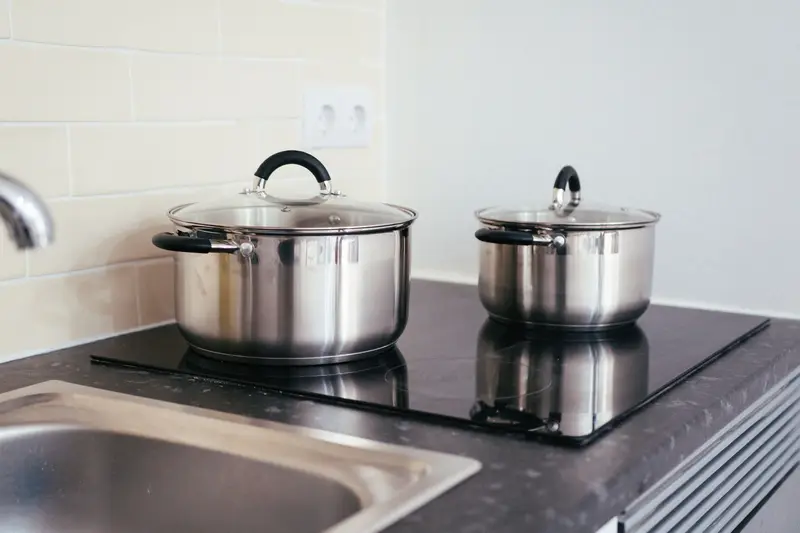
Turn on a gas burner and a flame heats the pan. Turn on a conventional electric burner and a glowing coil or hot glass surface does the same. In both cases heat is made somewhere else and then handed to the pan. An induction cooktop breaks that pattern. There is no flame and no resistive element beneath the pan. Instead, a hidden coil produces an alternating magnetic field, and the pan itself becomes the heating element.
This is a direct application of one of the most important discoveries in physics: that a changing magnetic field can create an electric current in a nearby conductor. Once you understand that, the odd behavior of induction cooktops, such as their insistence on certain cookware and their cool surface, follows naturally.
The Principle: Induction
In August 1831, Michael Faraday wound two coils of wire around an iron ring. When he connected a battery to one coil, a brief current appeared in the other. It appeared again when he disconnected the battery, but not while the current was steady. Faraday had found that it is the change in a magnetic field that induces electricity, and he soon showed the same effect with a magnet moving through a coil.
Faraday's law of induction expresses this quantitatively: the electromotive force induced in a circuit equals the rate at which the magnetic flux through it changes. Heinrich Lenz added in 1834 that the induced current flows in the direction that opposes the change that produced it. Generators, transformers, electric guitar pickups and wireless phone chargers all depend on this same principle.
Step by Step
Under the ceramic-glass top of an induction cooktop sits a flat coil of copper wire. The following sequence takes place when you turn it on.
First, electronic circuits convert household current to alternating current at a much higher frequency, typically tens of kilohertz, and send it through the coil. Second, the alternating current produces a rapidly reversing magnetic field that extends above the cooktop. Third, when a suitable pan sits in that field, the changing flux induces circulating currents inside the metal of the pan's base. These loops of current are called eddy currents. Fourth, the metal has electrical resistance, so the eddy currents dissipate energy as heat, in the same way that current heats the filament of a toaster. Fifth, that heat spreads through the pan and into the food.
The glass top is not part of this circuit. It is a bystander that lets the field through. It becomes warm only because the hot pan is touching it, which is why the surface cools quickly once the pan is removed and why a hand held near a running burner without a pan feels nothing.
Why the Pan Must Be Magnetic
Not every pan works. Most cooktops require cookware made of, or containing, a ferromagnetic metal, such as cast iron or magnetic stainless steel. Two effects add heat in such a material. The eddy currents produce resistive heating, as described above. In addition, the rapidly reversing field repeatedly flips the magnetic domains inside the iron, and that reversal wastes a little energy as heat too. Iron also has high permeability, so it concentrates the magnetic field and couples strongly with the coil. Because of the skin effect, the currents at these frequencies flow in a thin layer near the pan's underside, which concentrates the heating in the right place.
Aluminum and copper are the opposite. They conduct so well that eddy currents meet little resistance and generate little heat, and they are not magnetic, so they couple poorly to the coil. That is why a typical aluminum pan sits on an induction hob doing nothing. Some cookware combines a magnetic steel plate on the base with an aluminum or copper core, spreading heat well. Newer designs can drive higher frequencies to work with more materials, but the simple magnet test remains a reliable guide for ordinary cooktops: if a magnet sticks firmly to the pan's base, it will most likely work.
A Brief History
The idea is more than a century old. Patents describing induction heating for cooking appeared in the early 1900s, including one by Arthur Berry in the United Kingdom in 1906 and another by Simon Hohlfeld in Germany in 1909, but the electronics to drive coils at useful frequencies did not yet exist. Prototypes appeared in the 1950s. Modern development began in the early 1970s at Westinghouse, which showed a cooktop it called the Cool Top Induction Range in 1971. Later decades brought cheap power semiconductors, which made induction cooktops practical for ordinary kitchens.
The same physics runs industrial furnaces that melt metal without any flame, and the surface hardening of steel parts. A cooktop is a gentle, small-scale version.
Everyday Effects
Because the pan is heated directly, induction responds almost instantly to changes in power. Turn the control down and the eddy currents fall immediately, without waiting for a hot coil to cool. Little energy is wasted heating the air or the burner, so more of the electricity reaches the food. Tests generally find that a larger share of the electricity reaches the food than with a conventional electric element, though the exact figure depends on the pan and the cooktop.
Induction hobs also stay comparatively cool, which reduces burns and makes spills easier to clean, since food does not bake onto a hot surface. A cooktop can detect when a pan is missing or too small and reduce or cut power. Kitchen design is affected too: the coil's field is confined largely to the region around each burner, so induction elements can sit close together.
There is a family resemblance to another kitchen device. A microwave oven also heats its target directly rather than heating the air around it, but it uses radio waves absorbed by water rather than magnetic induction in metal. The physics is different, and it is why a microwave cannot heat an empty steel pan and an induction cooktop cannot heat a glass bowl of soup.
Limits and Misconceptions
One misconception is that induction cooktops are radioactive or dangerous because of the magnetic field. The field is a low-frequency, non-ionizing field that falls off quickly with distance, and it does not affect food. People with implanted medical devices are typically advised to follow the maker's guidance on distance, as they would with any equipment that produces strong fields.
Another is that induction cooking is a flame-free version of the same thing. In fact, the heat distribution differs: the heating is concentrated where the pan touches the coil's field, so warped or undersized pans may heat unevenly. A third is that all stainless steel works. Some stainless alloys are not magnetic, and pans made of them will not respond.
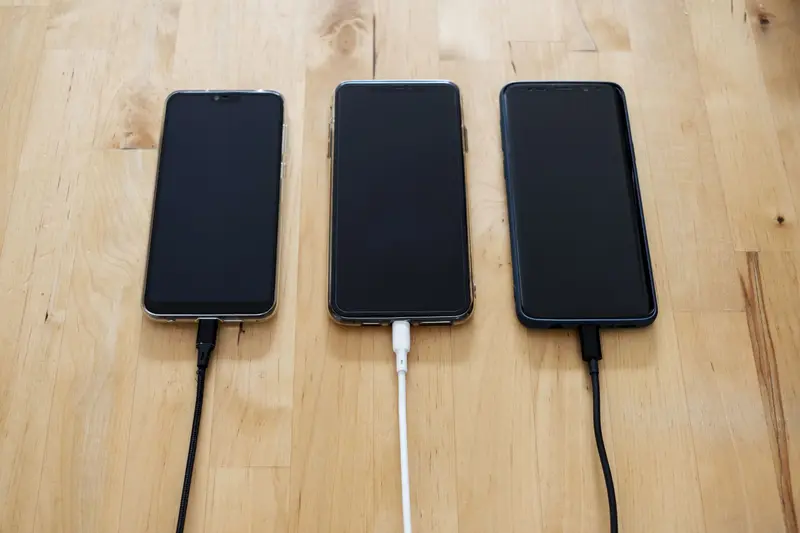
A related question is whether induction relates to wireless charging. The answer is yes, at heart. A phone charger uses a coil to make a changing field, and a coil in the phone captures it. The difference is that a charger is designed to minimize eddy-current losses in nearby metal, while a cooktop is designed to maximize them. The energy transferred ends up in a device's rechargeable battery instead of a pan, and the limits on how fast that energy can be accepted are covered in the article on what happens during fast charging.
In Short
An induction cooktop turns electricity into an alternating magnetic field. When a magnetic pan sits in the field, eddy currents flow through it and warm it directly, with extra heating from magnetic reversal in the iron. That is why the pan needs to be ferromagnetic, why the surface stays cooler than a conventional burner, and why power changes take effect almost at once. It is Faraday's 1831 discovery, made into a stove.