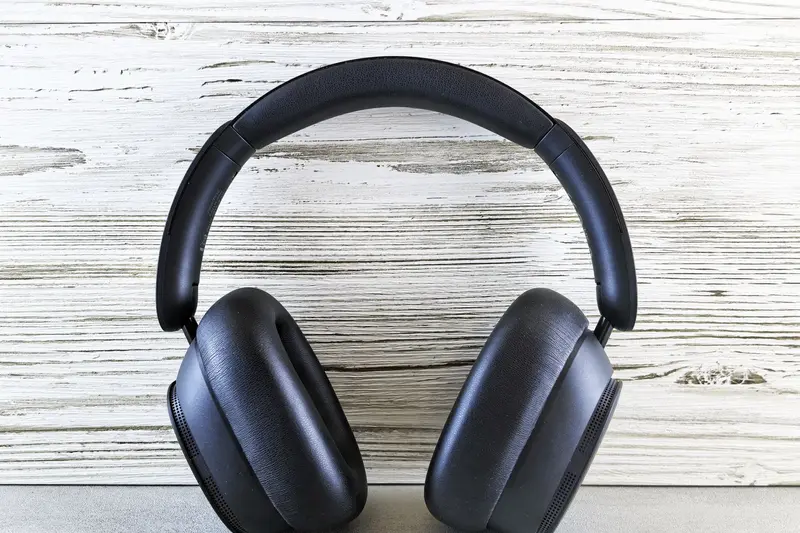
Sound is a wave of pressure. When a jet engine, a train, or an air conditioner produces noise, it makes the air alternately compress and thin out, and the changes travel to the ear where the eardrum follows them. Active noise cancellation, usually abbreviated ANC, relies on a simple observation about waves: if two waves of equal size meet with one's peaks aligned to the other's troughs, the sum is close to flat. Noise-cancelling headphones try to produce that second wave on demand, right at the ear.
The phenomenon is called destructive interference, and it is the same principle that makes ripples on a pond partly cancel where they cross. The difference is that a headphone must build the opposing wave in real time, from a noise it has only just detected, and put it in the right place at the right moment.
How the Circuit Does It
A pair of ANC headphones contains at least one small microphone, an electronic processor, and the same speaker that plays music. The process is a loop:
- The microphone measures the sound reaching the ear cup.
- The processor inverts the signal, flipping its polarity so that every rise becomes a fall, and adjusts its timing and strength for the acoustics of that particular ear cup.
- The speaker plays this inverted signal, called anti-noise, along with any music.
- Near the ear, the noise and the anti-noise overlap, and the pressure changes largely cancel.
The result is not silence but a reduction, and the reduction depends on how accurately the anti-noise matches the noise in amplitude and timing. A mismatch of a few percent in level, or a small shift in timing, leaves a residual. Modern headphones therefore use digital signal processing, and often adaptive filters that constantly adjust as the fit or the noise changes.
Feedforward, Feedback, and Hybrid
Designers place microphones in two ways. In a feedforward system, the microphone sits on the outside of the ear cup. It hears the noise before it arrives at the ear, which gives the electronics a small head start. The drawback is that it cannot check whether the cancellation actually worked, because it never hears the result.
In a feedback system, the microphone sits inside the ear cup, next to the speaker, and hears what the wearer hears. The processor can then measure the leftover noise and correct it, in the same way a thermostat responds to the actual room temperature. The drawback is that feedback loops can become unstable if pushed too hard, and they work over a narrower frequency range.
Many products combine both in a hybrid design. The external microphone handles the bulk of the cancellation, and the internal one trims the remainder. Some designs also use microphones to pass outside sound through to the wearer, so that an announcement or a voice can be heard without removing the headphones.
Why Steady, Low Sounds Work Best
Two limits shape what ANC can do. The first is time. Electronic processing and the speaker itself take a fraction of a millisecond, during which the sound has moved on. For a slow, low-frequency wave, that delay is a small part of one cycle, and the anti-noise still lines up. For a high-frequency wave, the cycle is so short that the same delay can turn cancellation into reinforcement. That is why ANC is very effective on the drone of an aircraft engine or the rumble of a bus, and much less so on a sudden clatter, a sharp voice, or a crying baby.
The second is space. Cancellation works only where the two waves overlap with the right relationship. At the ear, inside a small sealed volume, the wavelengths of low-frequency noise are long compared with the cup, so the wave is nearly uniform across it. In open air the story is different. As Scientific American notes, in open spaces the three-dimensional wave fronts can produce zones of cancellation and other zones where the noise is doubled. This is why the technique became practical in headphones and cabins, where the region to be quieted is small, and why cancelling the sound of a room from a distance remains a much harder problem.
Where the Idea Came From
Inventor Paul Lueg, who first filed in Germany, was granted US Patent 2,043,416 in 1936, titled "Process of Silencing Sound Oscillations." It describes picking up unwanted sound with a microphone, amplifying it, and reproducing it with opposite phase through a loudspeaker. The vacuum-tube electronics of the time made real-world use difficult, and the idea waited for cheap, fast, small circuits. Practical systems arrived much later, first where noise is intense and steady, such as aircraft, and consumer headphones followed once integrated circuits and compact microphones became inexpensive.
A simple analogy helps. Imagine pushing a child on a swing while a friend pushes the opposite way with exactly the same force at exactly the same moment: the swing does not move. If the friend is late, or pushes a little harder, the swing still moves, only less predictably. The headphone is that friend, and the quality of its timing decides how still the swing stays. This is also why the wearer's fit matters: the microphones and speaker are tuned for the acoustics of a sealed cup against the head, and a gap changes those acoustics.
What Headphones Cannot Do
ANC does not remove all noise, and it is not a substitute for physical isolation. Higher-frequency sounds are best blocked passively, by a snug seal and dense materials that absorb and reflect them. The best headphones use both methods, with electronics handling the low rumble that materials handle poorly and the physical design handling the rest.
There are also everyday costs. The electronics need power, so ANC reduces battery life. Nor does cancellation remove sound that has already entered the ear canal through leaks: a poor fit reduces performance because the anti-noise no longer matches what reaches the eardrum. Finally, ANC is not the same as hearing protection. It reduces annoying noise, but it does not necessarily reduce loud sounds to a safe level.
The processing of sound signals in these systems is related to the techniques behind voice assistants that recognize commands, which also rely on microphones and rapid digital analysis, and the wireless links that carry music to many headphones are covered in how Bluetooth connects nearby devices. Because the electronics run on a battery, the design also depends on how rechargeable batteries store energy.
In Short
Noise-cancelling headphones measure unwanted sound with microphones, flip its polarity electronically, and play the mirror image through the speaker so that the two waves cancel near the ear. The scheme works best for steady, low-frequency noise in a small enclosed space, and it is complemented by a good physical seal. It reduces the world rather than erasing it, and it does so by exploiting one of the simplest facts about waves.