
Look at the top-left letters of almost any keyboard and you will find the same sequence: Q, W, E, R, T, Y. The arrangement looks arbitrary, and it has been blamed on everything from deliberate sabotage to plain carelessness. The truth is more interesting. QWERTY is a fossil from the 1870s, when the physical behavior of metal levers dictated how a keyboard could be organized, and it survived because keyboards became a shared standard long before anyone could easily replace it.
The layout comes from the typewriter developed in Milwaukee by Christopher Latham Sholes, Carlos Glidden, and Samuel Soule, who began work in 1866. Their early prototype used a semi-sequential arrangement of letters. After roughly thirty test models, the design settled on the QWERTY pattern that we recognize. The first commercially successful version was built by E. Remington and Sons, which signed a manufacturing contract in 1873 and put the machine on sale in 1874. Almost every keyboard since has descended from that arrangement.
Understanding why the layout looks the way it does means looking inside that machine, and then at the reasons the pattern outlived it.
How a Typewriter Made Letter Order Matter
Inside the Sholes and Glidden machine, each letter was cast on the end of its own metal lever, called a type-bar. The bars sat in a circle beneath the paper. When a typist pressed a key, the corresponding bar swung upward and struck the page through an inked ribbon, then fell back into place.
This design had a weakness. If two neighboring bars were pressed in quick succession, the first might not have dropped far enough before the second rose, and the two levers could collide and jam. The machine would freeze until the typist untangled the metal.
Moving letters was a cheap fix. The Lemelson-MIT profile of Sholes credits his business associate James Densmore with suggesting that keys for letters commonly used together be split up, so that their type-bars would not strike in quick succession. Rearranging the keys, and therefore the bars they controlled, reduced collisions without redesigning the mechanism. The keyboard was, in effect, a software patch applied to a hardware limitation.
That helps explain why some frequent pairs, such as "th", are not side by side on the keyboard. It also explains why the layout is not optimized for fast typing in the modern sense. Its designers cared about keeping the machine running.
A Story With Competing Explanations
The popular claim is that QWERTY was designed "to slow typists down." That is a compressed and slightly misleading version of the jamming explanation. Separating awkward letter pairs does reduce the chance of collisions, but the goal was reliability, not sluggishness.
Some historians question even the jamming story as a complete account. As the Smithsonian Magazine feature on the layout explains, some more recent historians argue the arrangement was designed specifically to help telegraphists avoid common errors when transcribing Morse code. On that account, letters that are easily confused when copying Morse code were placed apart.
This is a good reminder that a clean origin story is rare. Prototype machines went through many revisions, records are incomplete, and different motivations may have overlapped. What can be stated with confidence is narrower. The layout emerged from testing on a mechanical machine with type-bars, and Britannica notes that the key positions on the first Remington conform almost exactly to the arrangement that is now universal.
How It Became the Standard
A typewriter that people learn on becomes a standard almost automatically. Once typists trained on this arrangement and employers hired them, competitors had strong reasons to copy it. Each new manufacturer that offered a different layout would have had to persuade every buyer to retrain staff.
This pattern, in which an early choice becomes locked in through the cost of change, is common in technology. The same reasoning applies to electrical plugs, railway gauges, and file formats. The QWERTY arrangement did not need to be the best possible option. It needed to be good enough and familiar to a large enough population.
The layout then crossed from mechanical to electric typewriters, to early computer terminals, and to personal computers. By the time the type-bar problem disappeared, the arrangement had spread far beyond the machines that justified it. IBM's Selectric typewriter, introduced in 1961, replaced the type-bars with a rotating type element, yet it kept the same keyboard because the people using it expected it.
Alternatives and Everyday Reality
Other arrangements have been proposed for more than a century. The best known, the Dvorak layout, places the most frequent letters on the home row. Alternatives such as Colemak keep more of the QWERTY arrangement while improving frequency placement. Some users report comfort or speed benefits after switching, and the layouts are supported by mainstream operating systems.
The evidence that any of these gives a large, reliable advantage for typical users is weaker than enthusiasts often claim. Typing speed depends heavily on practice, and most people who are fluent in one layout do not gain enough from another to offset the effort of relearning. Meanwhile, shortcuts, printed keycaps, and shared computers all assume QWERTY.
The layout also shows up where physical keys do not exist. Touchscreens on phones and tablets reproduce QWERTY on glass, even though no lever can jam. Here the arrangement functions purely as a familiar map. Users can find a letter without looking at it closely because their memory of where it sits was built on decades of prior keyboards. Predictive text and swipe typing changed how phones handle input, yet they still rely on that map. For how the screen registers your finger on such a keyboard, see How a Touchscreen Detects Your Fingers.
Local variants exist as well. Some languages use modified versions, such as AZERTY or QWERTZ, that move a few letters to suit the frequency of characters in that language. They keep most of the original structure, which again shows how strongly the base pattern persisted.
Common Misconceptions
Several statements about QWERTY circulate widely and need care.
The first is that the layout was designed to slow typing. As described above, it was arranged to lessen jams, and the telegraph-related explanation is debated among historians. The second is that all letters in the top row were selected so that salespeople could type the word "typewriter" quickly. That is a curious coincidence that appears in the top row, but it is not a well-documented reason for the design and should not be treated as one. The third is that QWERTY has been scientifically proven inferior. Controlled comparisons of layouts are few and their results are contested, so the strongest claim that can be defended is that other layouts reduce finger travel, not that they transform productivity.
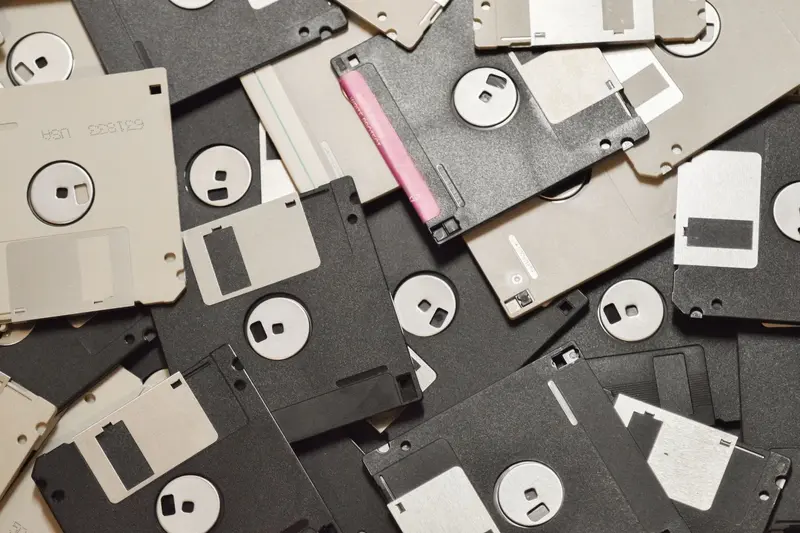
It also helps to remember that the keyboard is only one of several inherited conventions in computing. Icons and interface symbols often preserve old physical objects in a similar way, as with why the save icon is a floppy disk. If you are curious how many technology beliefs mix fact with folklore, Common Tech Myths Explained with Evidence works through several.
In Short
QWERTY began as a practical arrangement for a nineteenth-century machine whose metal type-bars could jam, possibly shaped as well by the needs of telegraph operators. It became a standard because teachers, employers, and manufacturers all adopted it, and every new device inherited the habit. Its persistence says less about the merits of the arrangement than about how strongly shared conventions resist change, even after the machine that created them has vanished.