Unlocking a phone with a fingertip or a glance feels instant and almost effortless. Behind it is a chain of measurement and statistics. A biometric scanner does not carry a photograph of your face and squint at it. It captures a signal from your body, reduces it to a set of numbers, and compares those numbers with a stored version to decide whether they are similar enough.
The National Institute of Standards and Technology describes biometrics as the measurement of physiological characteristics such as fingerprint, iris patterns, or facial features, used to identify individuals. The idea is old, but the engineering that makes it work at scale is largely a matter of two questions: what should be measured, and how much difference is acceptable?
The Common Pipeline
Nearly every biometric system, whatever the trait, follows the same sequence.
First comes capture. A sensor records the trait: a fingerprint image, a photograph or depth map of a face, or an image of an eye.
Second is quality control and preprocessing. The software checks whether the sample is usable, for example whether the finger was pressed firmly, the face was well lit, or the eye was open. It then normalizes the image by cropping, rotating, or scaling it.
Third is feature extraction. Algorithms pick out the measurements that distinguish one person from another and convert them into a numeric summary called a template. The template is not an image. Ideally, it is difficult to turn back into one.
Fourth is enrollment. The first time you set up the device, the system stores your template.
Fifth is comparison. Every later attempt produces a new template, and the software computes a similarity score against the stored one. If the score passes a threshold, access is granted.
The word "verification" describes a one-to-one check, such as confirming you are the owner of a phone. "Identification" describes a one-to-many search, such as finding a person in a large database. The second task is harder, because every added comparison creates another chance for a mistaken match.
Fingerprints
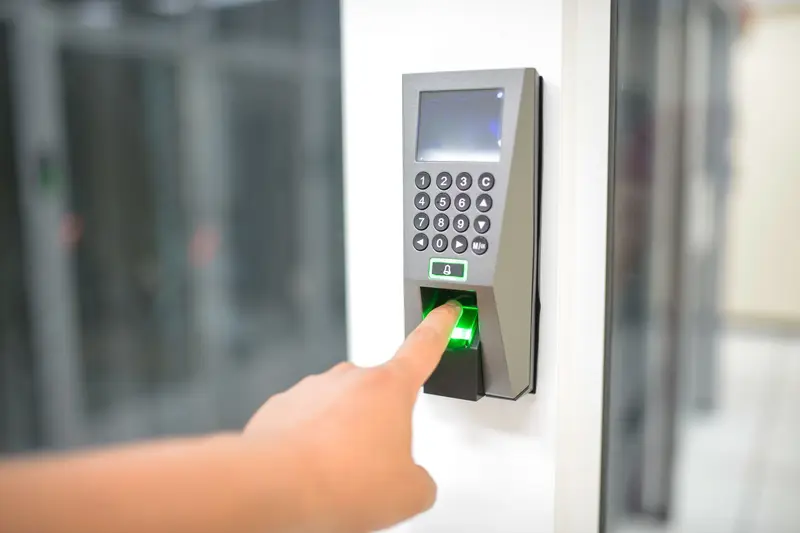
A fingerprint is a pattern of raised ridges and valleys on the skin. Fingerprint systems typically look at ridge endings and places where a ridge splits in two. These features are called minutiae, and a template often records where each one is and which way it points. NIST describes such minutiae templates as mathematical representations of a fingerprint image that are a fraction of the size of the image itself.
The sensor can gather the pattern in several ways. An optical sensor photographs the finger under illumination. A capacitive sensor measures how the ridges, which touch the surface, and the valleys, which do not, affect small electrodes. The physics resembles that of a touch panel, discussed in How a Touchscreen Detects Your Fingers. An ultrasonic sensor emits sound pulses and measures how they reflect from ridges and air pockets.
NIST has studied fingerprint technology for decades, including research for the Federal Bureau of Investigation that began in the 1960s. It runs evaluations that test whether matching software from different companies can work with standardized templates, and how accurate each one is.
Faces
Face recognition analyzes the geometry and texture of the face. Older systems measured distances between landmarks such as the eyes, nose, and mouth. Current systems mostly use machine-learning models trained on very large collections of images. Given a face, the model produces a list of numbers, sometimes called an embedding, in which images of the same person land close together and images of different people land far apart.
Some phones add a depth sensor that projects a pattern of infrared dots and reads its distortion to build a three-dimensional map. This makes it harder to fool the system with a flat photograph.
NIST evaluates face algorithms through its Face Recognition Technology Evaluation, which covers one-to-one verification and one-to-many searches, and through a companion program on tasks such as detecting altered images and attempted spoofing. Independent testing matters because performance varies widely among algorithms and conditions.
Irises
The iris is the colored ring around the pupil. Its fine texture of ligaments, crypts, and furrows begins to form in the third month of gestation and is largely complete by the eighth, and it is stable enough over time to serve for recognition. Even the two eyes of one person have unrelated patterns, which suggests the detail arises from random events during tissue formation rather than from genes alone. John Daugman at Cambridge University published an influential method in 1993 that filters the iris image with Gabor wavelets and converts the result into a compact binary code. Two codes are compared by counting how many bits differ, and a low count means the same eye.
Iris cameras generally use near-infrared light. In that range, even darkly pigmented irises reveal rich and complex features. NIST's IREX program evaluates iris recognition performance, image quality, compression, and how well iris patterns hold up over time, and describes the iris as a very powerful biometric.
The Error Trade-Off
No biometric system is perfectly certain. Two samples of the same finger will never be identical, because of pressure, moisture, angle, or a small cut. So the software cannot demand an exact match. It sets a threshold, and the threshold determines two kinds of error.
A false match occurs when the system accepts someone who is not the enrolled person. A false non-match occurs when it rejects the correct person. Lowering the threshold makes the system more forgiving and raises false matches; raising it makes the system stricter and increases false rejections. Engineers pick the balance based on the application. A phone might tolerate more false rejections to keep fraud rare, since you can simply try again, while a door that must not lock out staff during an emergency might favor convenience.
That is why headline claims about accuracy should always be read alongside the conditions of the test. A number means little without the error rate it was measured at, the population, and the quality of the samples.
Limitations and Misconceptions
One misconception is that your fingerprint or face is stored as a picture that thieves could copy directly. Well-designed systems keep a template, usually in protected hardware, rather than a raw image. But this depends on the implementation, and a breach of a database of templates is still a serious problem, because unlike a password, you cannot change your iris.
Another misconception is that biometrics are unbeatable. Attackers can try presentation attacks, such as a printed photo, a replica fingerprint, or a mask. Countermeasures include depth sensing, checking for signs of life, and analyzing texture. These are the subject of continued testing, and none is a guarantee.
Biometrics also identify rather than authorize. A match shows that the sample resembles an enrolled template, not that the person intends to give access. Because of that, secure systems often pair a biometric with another factor, such as a device passcode after several failed attempts or after a restart. The passcode, in turn, is protected by the techniques in How Encryption Protects Information.
Finally, biometrics are not equally reliable for everyone or in every setting. Worn fingertips, wet hands, low light, aging, and injuries can all lower accuracy. Some claims made about any technology are more myth than fact, as Common Tech Myths Explained with Evidence illustrates.
In Short
A biometric scanner captures a trait, extracts distinguishing measurements into a numeric template, and compares new samples against it using a similarity threshold. Fingerprints rely on ridge minutiae, faces on learned numeric embeddings, and irises on binary codes of texture. Because no two samples are identical, every system trades false matches against false rejections, and independent testing, such as that carried out by NIST, is how those trade-offs are measured.