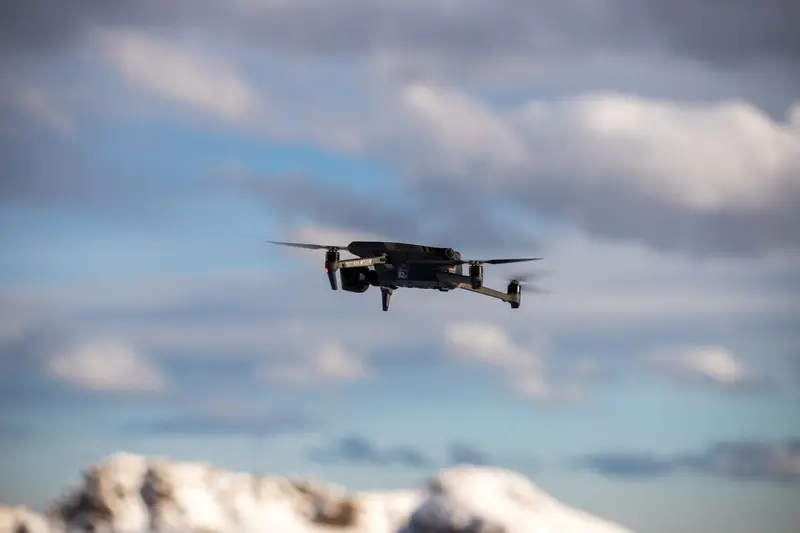
A quadcopter is, in aerodynamic terms, a machine that wants to fall over. It has no wings that generate stabilizing forces and no long tail acting as a weather vane. Four small propellers hold it up, and if any one of them delivers slightly more or less thrust than it should, the aircraft begins tilting, and tilting turns into sliding and tumbling within a fraction of a second. Yet a modern drone hangs motionless in a breeze, and the reason has almost nothing to do with the airframe. It is a computer, a handful of tiny sensors, and a very fast feedback loop.
Understanding that loop reveals a principle that runs through nearly every robot: instead of building a machine that is stable on its own, engineers often build one that is unstable but controllable, then let software do the balancing. A person cannot fly an early quadrotor by hand for long; a microcontroller can hold it steady while the pilot only expresses intent.
Three Axes and Four Rotors
Any aircraft can rotate about three perpendicular axes that meet at its center of gravity. Pitch tips the nose up or down, roll tips one side down, and yaw swings the nose left or right. NASA's educational material describes them precisely this way, noting that on a conventional airplane the rudder, elevators, and ailerons create torques about these axes.
A quadcopter has none of those surfaces. It controls all three rotations, plus vertical lift, by varying the speed of four rotors. Increasing the speed of all four raises the drone; decreasing all four lowers it. Speeding up the two rear rotors while slowing the front pair tips the nose down and pushes the craft forward. Doing the same to the left or right pair produces roll. In each case the tilt redirects part of the total thrust sideways, so the craft accelerates in the direction it leans.
Yaw is handled through a clever use of torque. A spinning propeller pushes air one way and, by Newton's third law, experiences a twisting reaction the opposite way. A single-rotor helicopter needs a tail rotor to cancel this. A quadcopter instead spins two propellers clockwise and two counterclockwise, placing like-turning pairs on opposite corners. When all four run at the same speed, the reaction torques cancel and the net torque about the yaw axis is zero. To turn, the controller speeds up one pair and slows the other, leaving a deliberate imbalance that rotates the body.
Sensing Motion: The Inertial Measurement Unit
To correct tilt, the flight controller must first know how the aircraft is oriented. It does not see the horizon; it feels motion through an inertial measurement unit, a chip that combines gyroscopes, accelerometers, and often a magnetometer. Gyroscopes report how fast the craft is rotating around each axis. Accelerometers report the specific force acting on it, which includes gravity and therefore reveals which way is down when the drone is not accelerating hard. Magnetometers sense Earth's magnetic field and supply a heading reference.
These sensors are microscopic mechanical structures etched into silicon, which is why they are cheap and light enough for a toy. Each has weaknesses. Gyroscopes are smooth and fast but drift slowly over time. Accelerometers give a stable reference to gravity but are jostled by vibration and motion. Position is worse: to obtain it from an accelerometer, the signal must be integrated twice, so a constant error in acceleration grows linearly in velocity and quadratically in position. This is why an inertial system alone cannot navigate for long.
The solution is to blend the sensors. Algorithms combine the gyroscope's short-term accuracy with the accelerometer's long-term stability, weighting each by how trustworthy it is at that moment. The same idea underlies the sensor blending described in how robots perceive their surroundings, and for outdoor position a receiver of the kind explained in why GPS depends on extremely precise clocks supplies the external correction the inertial sensors lack.
Closing the Loop: PID Control
Once the controller knows the current tilt and the desired tilt, it needs to decide how much to change each motor. The most widely used answer is the PID controller, which sums three terms computed from the error, the difference between where the drone is and where it should be.
The proportional term reacts to the present error: the larger the tilt, the stronger the correction. Used alone, it tends to overshoot and oscillate, like a person overcorrecting a steering wheel. The derivative term reacts to how fast the error is changing, so it acts as a brake that damps the motion before overshoot occurs. The integral term accumulates past error, so a small persistent offset, perhaps from an unbalanced battery or a steady crosswind, gradually earns a larger correction until it vanishes.
The idea is older than aviation. In 1922, the engineer Nicolas Minorsky formalized three-term control after studying how helmsmen steer ships, who respond to the current deviation, its recent history, and its rate of change. A drone applies the same reasoning to each axis, typically hundreds or thousands of times per second, sending new speed commands to the motors each time.
History and Why It Became Practical
Rotorcraft with four lifting rotors were built in the early twentieth century, but pilots struggled to control them, and the workload was high. What changed was electronics. From roughly 2005 to 2010, low-cost lightweight flight controllers, accelerometers, gyroscopes, and batteries reached the point where software could do the balancing. Because a quadcopter has fixed-pitch propellers and changes only their speed, it is mechanically simple, with no complicated pitch-changing mechanisms like those in a traditional helicopter. Electric motors respond in milliseconds, which the control loop requires; a slower engine could not keep up.
Battery chemistry matters as well. The energy stored in cells like those described in how rechargeable batteries store energy sets flight time, and the weight of the cells limits how much a small drone can carry.
Everyday Uses
Stability enables usefulness. Photographers use drones because their gimbal-mounted cameras stay steady while the aircraft holds a position, a job that also relies on the light-gathering principles in how digital camera sensors capture images. Farmers inspect crops, engineers survey bridges and roofs, and rescuers search terrain that is hard to reach. In each case, the value comes from a platform that will stay where it is placed without constant attention.
Limits and Misconceptions
A common assumption is that drones hover because the propellers generate a perfectly balanced push. In fact, hovering is a continuous series of small corrections, and the drone is never truly at rest in the control sense. Wind, battery sag, and vibration all disturb it constantly. Another misconception is that GPS keeps a drone level. GPS gives position, and it updates too slowly to prevent tipping; leveling comes from the inertial sensors. Indoors, where GPS signals may not arrive, drones can still hover using their inertial sensors plus cameras or other sensors that observe the floor.
Limits remain. Strong gusts can exceed what small motors can counter, and a failed motor leaves a quadcopter with too little control authority to remain balanced in the ordinary way. Flight time is short compared to the aircraft's complexity, because lifting mass with small propellers is energy-hungry.
In Short
A drone stays stable because software constantly fights its natural instability. Sensors measure rotation and force, a controller compares them to the desired orientation, and a feedback rule adjusts four motor speeds many times each second. The airframe supplies lift; the loop supplies balance.